Turn, turn, turn. How it has all turned.
In the long history of men, a few turning points stand out. Take the day the Spaniards met the Incas. In December of 1532, Henry VIII was trying to get a divorce that would tear Europe apart, but that was nothing compared to what was going on in Peru. Conquistador Francisco Pizarro led a rag-tag group of 198 soldiers to meet the Emperor Atahualpa, who had a standing army of 80,000 men. Pizarro told the Emperor that it would all be nice and friendly, and he should come unarmed. The Incas didn’t know much about Europeans.
It took a few decades to wipe out the Incas completely, the colonialists swept along on a wave of smallpox and lying. But that day is considered to be the main turning point. The Spanish slaughtered 7,000 unarmed Incas and took the Emperor hostage without losing a single man. Popular themes when discussing how they overturned odds of 400-1 are the presence of steel and horses, and of course, the fact that the invaders were evil bastards. But historians still argue about the finer details of what it was that made the Europeans so superior on the day. Sometimes, when I’m watching Ryan Gravenberch play, I think like this. Why is he so much better than all those other blokes? He’s clearly not carrying a wave of contagion, or concealing a blade. So… maybe he’s got a horse?
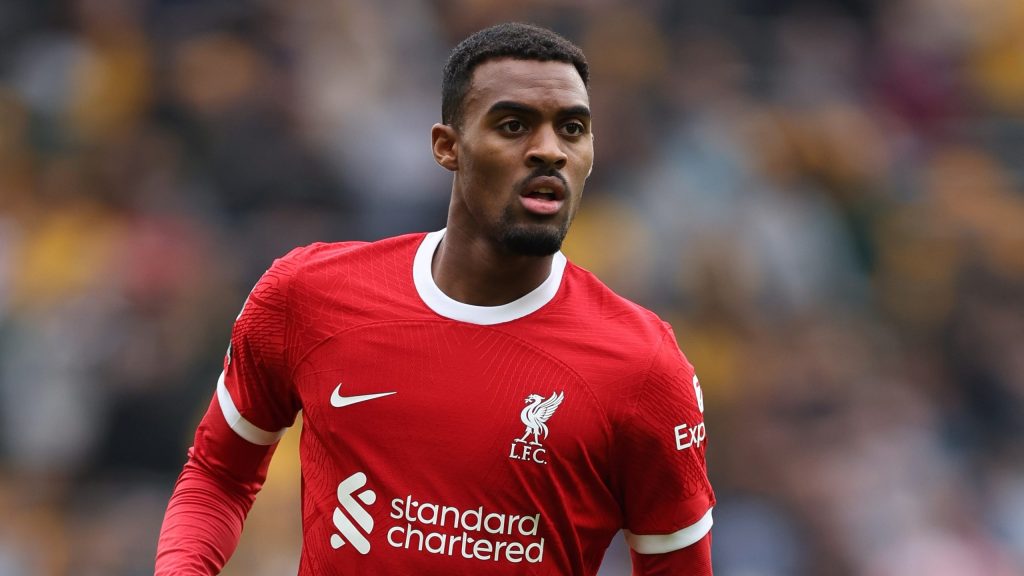
It seems unlikely. But then, sometimes when he accelerates away from the group of players he’s just ghosted, or when he’s hunting down a marauding interloper inside Liverpool’s penalty area, it does sort of look like it. He has a way of playing with his chin raised so high that it’s almost gravity-defying, like a man leaning back in his saddle (It’s a well-known fact that Gravenberch and Ibrahima Konate are in a private competition to have the most upright posture in Europe. Both players have grown an inch since joining Liverpool by sheer dint of trying). It seems unfair to allow someone to play football on horseback. It seems unfair to allow anyone to field Ryan Gravenberch in current form.
Like most fans, I was very happy with Liverpool’s midfield overhaul last summer, performed with the efficiency and economy of a battlefield surgeon. The canny acquisitions of Alexis Macallister and Dominic Szoboszlai were followed up with the even cannier swoop for Wataru Endo, who after a shaky start earned himself the confidence of the manager and the fanbase. But, I thought, why the deadline day move for an attacking midfielder who had struggled at Munich? We were already stocked in that department, and were still incubating Curtis Jones and Harvey Elliot, waiting for Trey Nyoni to hatch.
Gravenberch’s first season on Merseyside was forgettable. Introduced late, he struggled to make an impact when deployed higher up the pitch. There were moments of brilliance, flashes of a mercurial talent. But they were usually followed up with poor decision making and losing possession, leaving him skulking on the periphery of games with his head down. To me there was plenty of Dutch swagger, not enough meat and potatoes. Had he been sold this summer for a huge loss, I would not have mourned. I had written him off already. When someone suggested during the off season on Twitter that Ryan Gravenberch could be the answer for Liverpool at number 6 instead of Martin Zubimendi, I laughed it off. The kid had more holes in his game than a leaky colander, and would be ruthlessly exposed in a defensive role. We might as well put Atahualpa in nets.
How to account for such a turnaround in Gravenberch’s form? Well the horse, obviously. But what are the other factors? Having settled into a new team and a new city would have helped, as would the new Dutch coach putting faith in him from pre-season. And at 22 years of age, being one year older is a significant percentage of your time on earth so far. But surely it is this new system, playing Gravenberch deeper as part of a double pivot, allowing him to pick the ball up more frequently and dictate games, which is, somewhat implausibly, now playing to his strengths. He played this role at Ajax under Erik Ten Hag as a teenager, but it was thought that he preferred and was better suited to attacking football whilst in Bavaria.
A term that has been coined recently to describe players like Gravenberch is ‘press-resistant’. You’ll find it dripping from the pages of The Athletic, a publication which churns out neologisms and statistics like a group of Superbowl commentators at their Christmas party. The general consensus is that football has changed. It’s no longer your striker or your number 10 who are required to be most comfortable in possession: now it’s your centre-halves. The ubiquitous ethos of high-pressing means that even the most plucky underdogs are going to have their entire team besieging the edge of your box like it’s Rourke’s Drift. Your third-choice goalkeeper is now expected to play tiki-taka with the verve of a pot-bellied former Brazil international on the Copacabana.
Into this new reality then comes Ryan Gravenberch, and he is a thing to behold. Receiving the ball in tight spaces his touch, decision making and passing are exemplary. With his back to goal, his awareness and his ability to pirouette and spin away from his man at will is simply jaw-dropping. One of the most satisfying things to watch in football is a player who allows the ball to beat him and then rolls his man, using the pace of the ball to advance up the pitch. It takes extraordinary technique and vision, and often physicality. At Barcelona, the likes of Xavi, Iniesta, and Messi made such an art form out of it that there were entire goals scored without anyone touching the ball. The whole team just sold dummies and wheeled about like banshees until the ball ended up in the net. Gravenberch has made this his signature move, often deep inside his own half, turning defence into attack in the blink of an eye.
Liverpool are currently top of everything you can point at, and the current system revolves around Ryan Gravenberch. With Rodri out injured, and Declan Rice suffering a slump in form, it feels like the whole footballing world orbits Gravenberch right now. He’s got the numbers – in possession and out of it, he tops all of the little charts and infographics. At some point, Gravenberch will have a blip or suffer an injury, and it really is hard to imagine Liverpool’s embryonic title charge not suffering as a result. But it speaks volumes that this scenario causes greater concern in some quarters than the potential loss of Mohamed Salah or Virgil van Dijk. Suggestions that Liverpool are still shopping for a number 6, or could be tempted by a chastened Aurélien Tchouaméni or Martin Zubamendi in January have been dismissed dismissively by club sources.
I really can’t remember a more remarkable turnaround in a player’s form and importance over such a short period of time. Given his young age and Liverpool’s ascendancy under Arne Slot, it could be a turning point of great significance, and one that will be discussed for a long time to come. It’s a bit like the way Gravenberch spins away from his marker and bears down on the space in front of him like a medieval king routing the enemy. Sorry, I can’t help it. It really does feel like he’s on horseback sometimes. Regardless, we can all sit back and watch the spectacle unfold. Ryan has got his Grav back.